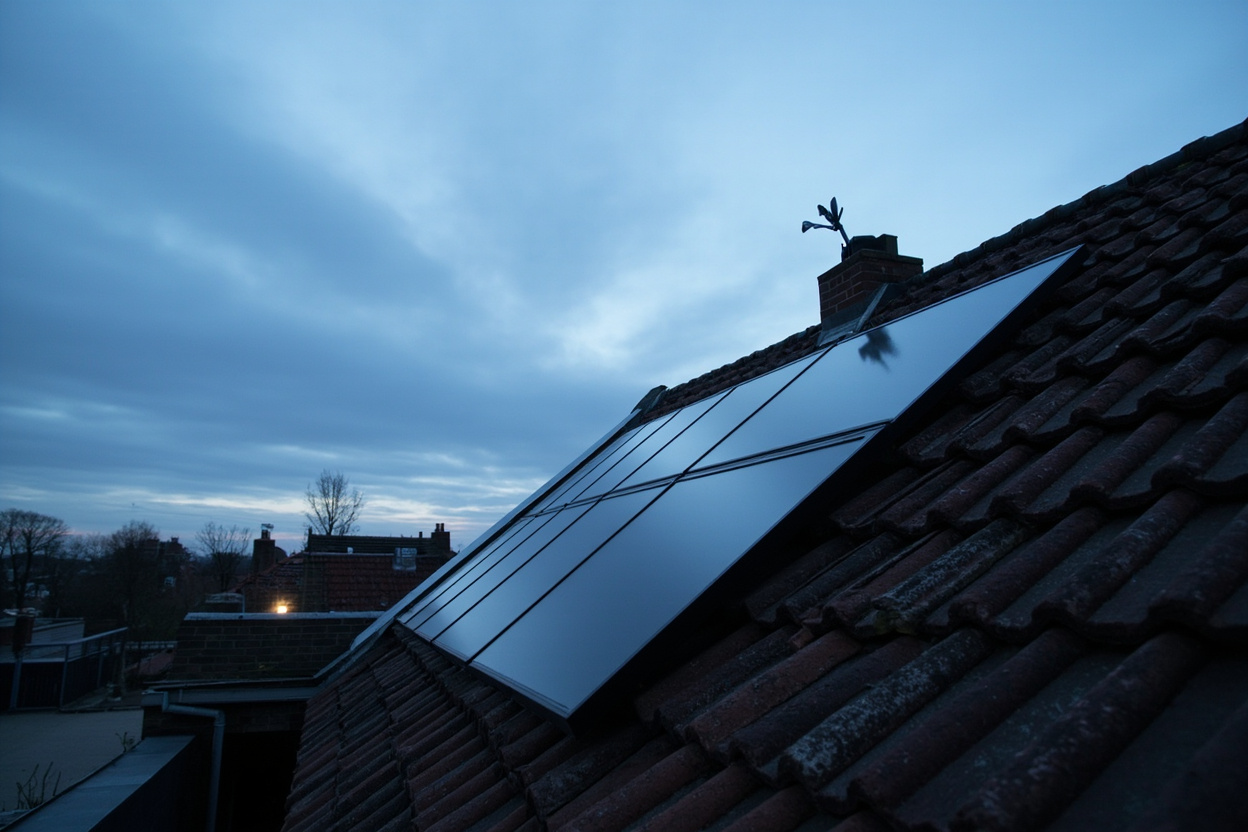
Haarlemmermeer
Solar panels in Hoofddorp
- per kWp a year facing south
- 850 to 950 kWh
- the condition near the Polderbaan
- cadmium-free
- a quote has to separate
- four line items
What a roof here produces, and the panel condition this municipality attaches to a permit
If you have moved here recently, the thing worth knowing first is not which panel to buy. It is that the rule which made Dutch solar so simple is about to be switched off on a fixed date, and that the arithmetic after that date is not the arithmetic in most of the sales material still in circulation.
1 January 2027, and why the date matters more than the panel
1 of 4
The Netherlands has run a scheme called the salderingsregeling: every kilowatt-hour you exported to the grid was simply subtracted from every kilowatt-hour you imported, at the same price. Your meter effectively ran backwards. That scheme stops on 1 January 2027. Not tapering, not in steps: it ends outright, and until 31 December 2026 it still applies in full.
From that date, import and export are settled separately. Power you use the moment you generate it saves you the retail price you pay, energy tax and VAT included. Power that leaves the house earns a feed-in payment, and the law puts a floor under that until 2030: at least half the bare delivery tariff, meaning the rate before any tax is added. Suppliers may also charge feed-in costs, the terugleverkosten, and those do not go away.
Take your annual statement and find two figures. The all-in price per kilowatt-hour that you pay is the first. The bare delivery rate in your contract, halved, is the second. On almost any Dutch bill those two sit at least a factor of two apart. That gap is the reason the shape of your consumption now matters more than the size of your roof, and it is why "how many panels fit" has stopped being the same question as "how many panels should I buy".
What a roof here actually produces
2 of 4
An installation in this country yields roughly 850 to 950 kilowatt-hours per kilowatt-peak per year, assuming the roof plane faces south at a pitch between thirty and forty degrees. An east-west layout gets about 85 percent of that, but spreads what it does produce across a longer day, which after 2027 is worth more than the headline figure suggests. A north-facing plane sits near sixty percent and rarely repays anything.
That orientation factor belongs in the quote. A yield in kilowatt-hours without the orientation it was calculated on is a number with no roof underneath it. Ask what comes off it again, too: a chimney, a dormer or a neighbour's aerial costs more than the patch it shades, because panels are wired in series and the weakest one sets the pace for the row.
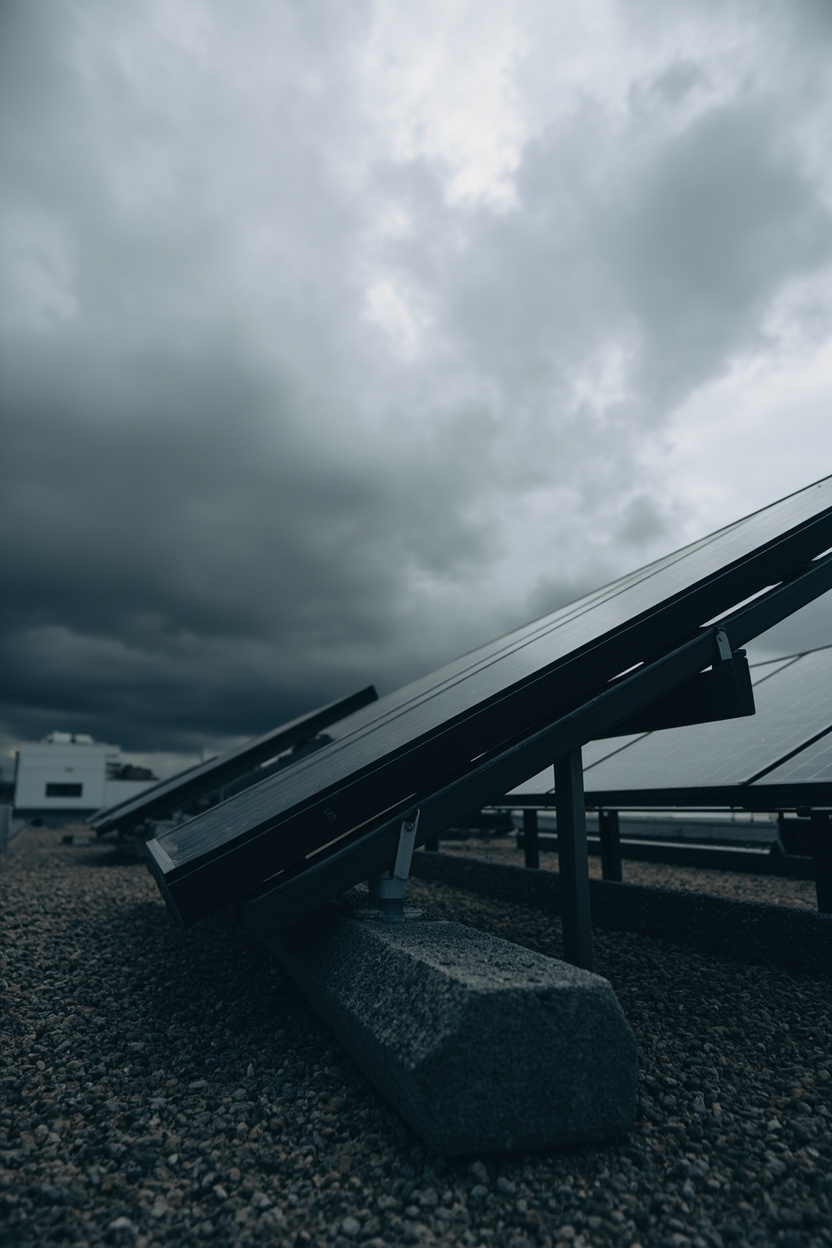
What is different in the polder is not shade but wind. Haarlemmermeer is flat and open, and on a flat roof panels stand on a ballasted frame rather than being bolted into a rafter. The edges of that field catch the most wind and get heavier ballast or extra anchoring than the middle. That is load on your roof structure, so the quote should state it in kilos per square metre.
The condition that applies only here
3 of 4
In July 2025 the Dutch transport inspectorate, the ILT, asked Haarlemmermeer to enforce against glare from a solar park near the Polderbaan runway. Schiphol won the case, and 78,000 of that park's 230,000 panels have to go. Since then the municipality grants permits on the condition that panels are cadmium-free and deeply textured. No other municipality in the Netherlands imposes it.
The two halves do different work. Cadmium-free rules out thin-film panels based on cadmium telluride: a materials question, not an optical one. The ordinary crystalline panels that go on houses contain no cadmium and already comply. Deep texturing is the optical half: a coarsely structured glass surface scatters the reflection in every direction instead of returning it as a beam, so a pilot on approach sees a pale patch rather than a flash.
Most pitched roofs in Hoofddorp need no permit at all, because panels lying in the plane of the roof are permit-free. Where the condition bites is a flat roof with a tilted array, a listed building, and any case where the municipality has to grant something for another reason. Either way, ask which glass the panel in your quote uses. It is one sentence, and it is the one question on this page your installer will not be expecting.
The four things a quote has to separate
4 of 4
One checkable fact per item. The panel: make, watt-peak, glass-glass or glass-backsheet, and the product warranty stated separately from the performance warranty. The inverter: string, micro or optimisers, with its rating, which may deliberately sit ten to twenty percent below the panel total. The mounting: hooks or ballast, with the number of roof penetrations and how each is kept watertight. And the electrical work: the circuit, the cable run, and the registration with your grid operator.
What is left out matters as much. Scaffolding, a penetration through a tiled roof that already leaks, a consumer unit that has to be replaced: these are the items that surface on the invoice when they were absent from the quote.
Why deeply textured glass gives no flash
incoming light
Smooth glass
The reflection leaves as a single beam.
A flash
incoming light
Deeply textured glass
The reflection breaks up in every direction.
A pale patch
Three things most quotes get wrong
Why the inverter is smaller than the panels
Panels only reach their rated peak on a clear, cold day around noon, which is a few dozen hours a year. An inverter rated ten to twenty percent below the panel total clips those hours and spends the rest of the year in its efficient band. Buying more inverter than that costs money and buys kilowatt-hours that were never going to exist.
One warranty is always three
Three clocks run at once: the product warranty on the panel, the performance warranty on what it must still deliver after twenty-five years, and the warranty on the installation itself. Each has a different length and a different party behind it. A quote that quotes one number is not quoting two.
Where the yield quietly leaks away
Soiling on a panel lying nearly flat, the December chimney shadow that falls long and low across a whole string, and the slow output loss every panel has. Individually each is small. Together they are the difference between the brochure and the meter reading.
From first visit to panels on the roof
Survey each roof plane
We record dimensions, pitch and orientation per plane, and note everything that casts shade: chimney, dormer, tree, aerial. Also the roof covering and its condition, because the mounting system depends on it.
about an hour
A proposal per roof plane
You get a breakdown per plane instead of one total: panel count, glass type, inverter, mounting system, and the items explicitly not included.
within five working days
Installation
Mounting system, panels, cabling, inverter, in that order. No roof work in the rain, and any penetration is closed on the day it is opened.
usually one day
Register and check
The system is registered with your grid operator. After that you read along in the inverter app for the first weeks, so a dead string shows up in week two rather than in June.
within two weeks
Cost depends mostly on the number of panels and on the roof underneath. For a typical terraced house with eight to twelve panels on a pitched roof, a complete installation usually falls between 3,000 and 5,500 euros. Add a second roof plane or optimisers and it moves towards 7,000 to 10,000. Since 2023 the supply and installation of panels on a home carries a zero VAT rate, so there is nothing to reclaim afterwards, which is a change from what older guides describe. Check which rate your installer applies per item, though: a home battery generally falls outside it.
How many panels fit is geometry, not taste. A common panel measures roughly 1.15 by 1.75 metres and delivers between 400 and 460 watt-peak. A roof plane of six by four metres takes ten portrait or nine laid landscape, and the clear margin the mounting system needs varies. Skylights and vent pipes then take some of that back, sometimes a whole panel and sometimes half a row.
Payback is no longer a single number after 1 January 2027. A household that is home during the day and consumes part of its own output immediately recovers the investment faster than one that locks the door at eight in the morning, even with identical roofs. The calculator on this site therefore asks how often you are home, not only about your roof, and returns a range rather than a figure: anything that has not been surveyed should stay wide.
After installation, the system is registered with your grid operator through the national register of generating installations. That is not a formality. Settlement of your export runs off that registration, and a system that is not in it still generates power but is not billed cleanly. An installer who does this for you says so in the quote.
We work only inside the municipality of Haarlemmermeer. That is the reason the Polderbaan permit condition weighs into every piece of advice here rather than sitting in a footnote.
Ranges, not promises. What your roof does follows from the survey, not from this figure.
Questions about solar panels in hoofddorp
Do I need a permit for solar panels in Haarlemmermeer?
Usually not for panels lying flush in the plane of a pitched roof: those are permit-free. A tilted array on a flat roof, a listed building and a number of other cases do need one. Where Haarlemmermeer does grant a permit, it does so on the condition that the panels are cadmium-free and deeply textured, because of glare towards the Polderbaan runway.
I have just moved here. What is the salderingsregeling?
It is the net-metering scheme that lets you subtract exported kilowatt-hours from imported ones at the same price, so your meter effectively runs backwards. It applies in full until 31 December 2026 and stops entirely on 1 January 2027, with no phase-out. After that, import and export appear as separate lines on your bill.
What does “cadmium-free and deeply textured” mean for the panel in my quote?
Cadmium-free excludes thin-film panels based on cadmium telluride; the ordinary crystalline panels used on houses contain none and already comply. Deep texturing is about the glass: a coarse surface scatters reflected light instead of concentrating it. Ask for the datasheet, which states the glass finish.
Will panels on a flat roof blow off in the polder?
Not if the ballast is right. On a flat roof panels sit on a frame held down by weight, and the edges of the field catch more wind than the middle, so they get more ballast or extra anchoring. The quote should say how many kilos per square metre that adds, because your roof structure has to carry it.
Do I have to register the installation anywhere?
Yes, with your grid operator, through the national register of generating installations. Without it the system still produces power, but the settlement of your exports does not run properly. An installer who handles the registration puts it in the quote.
Does a rented panel scheme make sense?
Renting costs nothing upfront, but most of the yield goes to the lessor and the contract follows the house when you sell it. Buying costs more at the start and keeps everything. Which one wins depends mostly on how long you expect to stay in the property.