Heat per kilowatt-hour
Heat pump in Hoofddorp
- the threshold your house must meet
- 50 degrees
- the ISDE amount for 2027
- not yet fixed
- when it draws, and your roof does not
- winter
The water temperature your house needs, and why the 2027 subsidy figure cannot be quoted yet
A heat pump is less a purchase than a conversion of your heating system. Whether one suits your house depends hardly at all on the brand and almost entirely on a single number: the water temperature your rooms need on the coldest day of the year.
The free measurement that decides everything
1 of 5
On a cold day, set your boiler's flow temperature to fifty degrees and leave it there for twenty-four hours. If every room comes up to temperature, a heat pump fits this house. If the living room lags, the question is not which heat pump but which radiator, which window and which floor comes first. The test costs nothing and tells you more than any brochure.
The reason is the efficiency curve. A heat pump earns its keep on the difference between outdoor and flow temperature. At a flow of thirty-five degrees, the sort underfloor heating uses, it delivers roughly four kilowatt-hours of heat per kilowatt-hour of electricity. At fifty-five it drops towards two and a half. That is not a small difference: it is close to half your heating bill. Every other choice on this page is minor beside it.
Hybrid or all-electric
2 of 5
A hybrid setup keeps the gas boiler and adds a small heat pump that does most of the year's work, with the boiler stepping in on the coldest days and for hot water. It fits almost any house, costs a third to a half of a full system, and needs no new radiators. The honest downside: you keep a gas connection and its standing charge, you maintain two appliances instead of one, and the last ten to fifteen percent of your gas use does not go away.
An all-electric air-to-water system removes gas entirely, but it makes demands: a low flow temperature, a cylinder for hot water, and usually larger emitters in the rooms that cannot keep up. If your house fails the fifty-degree test, the insulation and radiator work needed to pass it is what tips the comparison back towards hybrid.
What a heat pump does to your solar sums
3 of 5
This is where the most common assumption breaks. Panels produce most in May, June and July. A heat pump draws most in December, January and February. Those two do not coincide, and after 1 January 2027 they no longer cancel each other out through net metering either. A heat pump barely raises your summer self-consumption and raises your winter import considerably.
That does not make it a bad investment; it changes what you should expect from it. The gain is in replacing gas with roughly a third as much electricity, not in putting your roof to better use. Anyone presenting panels plus a heat pump as a closed loop is presenting a sum that ignores the calendar.
The subsidy, and why no honest quote names a 2027 figure today
4 of 5
The Dutch subsidy scheme for heat pumps, the ISDE, exists and continues. For a heat pump installed this year, this year's amounts apply, and you claim after installation on the basis of the invoice, not before.
For 2027 the position is different. From 17 July to 21 August 2026 an amendment to the ISDE was open for public consultation. It lowers the amount per kilowatt of capacity, aiming at an average subsidy intensity of thirty percent, while raising the bonus for the most efficient appliances. It also consults on two variants of a requirement that the appliance be smart-controllable, so it can respond to the grid or to a dynamic tariff. The regulation is due to be finalised later this year.
Hence a practical rule. If you are handed a quotation today for a 2027 installation with a firm subsidy amount in it, that quotation is naming a figure nobody has yet. Ask for the price with and without subsidy, and ask which appliance would satisfy a controllability requirement if one arrives. That is the difference between a quotation that survives January and one that has to be redone.
The consumption side of the grid
5 of 5
In Haarlemmermeer the network pressure is on consumption rather than export; Liander has published congestion research for this area on that side. For a household it becomes concrete in the consumer unit. A heat pump, a car charger and an induction hob share one main fuse, and a standard connection does not have unlimited room behind it. Load balancing is the cheap answer. A heavier connection is the other one, with a waiting time and a standing charge that runs for as long as the connection does.
The efficiency curve, and where your house sits on it
kilowatt-hours of heat per kilowatt-hour of electricity
flow temperature
- At 35 degrees, as with underfloor heating
- At 55 degrees
- The test: set your boiler to fifty degrees for a full day
Three things most quotes get wrong
The radiator decides, not the badge
A radiator gives roughly half as much heat at fifty degrees as it does at seventy. That is why a house with small panel radiators needs larger emitters before it needs a heat pump. Reverse that order and you have bought an appliance that spends every winter at its worst efficiency.
Hot water is its own calculation
Domestic hot water has to reach sixty degrees to keep legionella at bay, which is exactly where a heat pump performs worst. A cylinder with an immersion element that tops up is the usual answer, and that electricity is dearer than the rest of your heat. Ask for the efficiency figure for heating and for hot water separately.
The outdoor unit is a design decision
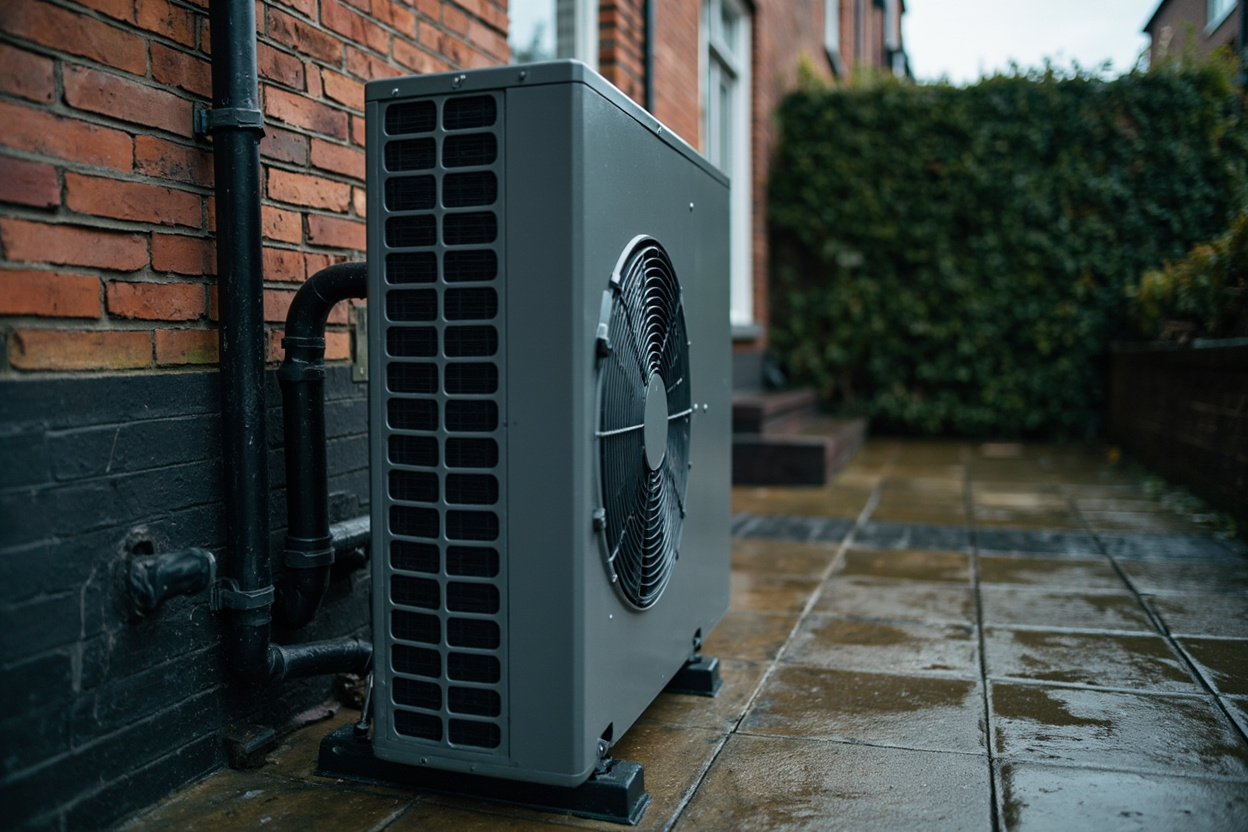
Outdoor units are subject to a noise limit measured at the neighbouring property boundary. That makes its position a choice made at the start rather than a leftover at the end: distance to the boundary, a wall that does not reflect, and anti-vibration mounts under the frame. Moving a unit afterwards costs more than placing it well would have.
From the fifty-degree test to a balanced system
The fifty-degree test
Before any quotation, you run your own boiler at a fifty degree flow temperature for a full day. We ask what each room did. If one stays cold, the conversation starts there and not at the appliance.
one cold day
Heat loss calculated per room
Not one figure for the house but one per room: emitter surface, glazing, insulation and target temperature. Capacity follows from that, and so does the list of radiators that have to change.
with the proposal
Installation
Outdoor unit on anti-vibration mounts and away from the boundary, indoor unit and cylinder, and the pipe penetration finished watertight and insulated.
two to four days
Balancing and the ISDE claim
Hydraulic balancing per radiator, the heating curve set, and then the subsidy claim on the basis of the invoice. The claim is made after installation, never before.
within two weeks of handover

Cost varies widely because two very different jobs share one name. A hybrid unit alongside an existing boiler usually lands between 5,000 and 9,000 euros installed. A full air-to-water system with a hot water cylinder generally runs from 12,000 to 20,000, before any new radiators or underfloor heating. The ISDE takes part of that off, at this year's rates for work done this year.
How much gas you save depends on the share the heat pump takes over. A hybrid setup typically covers sixty to eighty percent of the heat demand in an average house; all-electric covers all of it, but then the entire heat demand reappears on the electricity bill. Never look at the gas saving alone: the figure that matters is both bills added together, before and after.
Insulate first or fit the heat pump first is a sequencing question rather than an ideological one. Every measure that lowers heat demand also lowers the flow temperature required, and flow temperature is the dial the efficiency hangs on. Floor insulation, cavity insulation and replacing single glazing also repay themselves on their own terms.
A heat pump rarely needs planning permission, but the outdoor unit is subject to noise limits at the boundary with your neighbours. In a terraced house with a narrow garden that limit, rather than the capacity of the appliance, is what constrains the design. In an apartment, the owners' association has a say over the facade as well.
Most models can also cool, through the same floor or through fan coils. It is not air-conditioning and will not produce a cold draught, but it takes a few degrees off the summer peak. It draws power in exactly the months your panels produce most, which is the one point where panels and a heat pump genuinely complement each other.
We fit heat pumps across the municipality of Haarlemmermeer. The housing stock here is largely post-war and ground-level, which means the fifty-degree test is passed more often than in a pre-war city district. That is not a claim about your house; it is why we run the test first rather than adding it as a caveat later.
Ranges, not promises. What your roof does follows from the survey, not from this figure.
Questions about heat pump in hoofddorp
Will a heat pump work in my house?
It depends on the water temperature your house needs, not on the year it was built. Set your boiler flow to fifty degrees for a day when it is cold outside. If every room warms up, a heat pump fits. If one room lags, that room is where the conversation starts: a larger emitter or better glazing comes before the choice of appliance.
Do I have to insulate first?
Usually yes, and not on principle. Anything that lowers heat demand lowers the flow temperature needed, and that is what the efficiency depends on. Floor insulation, cavity insulation and replacing single glazing also repay themselves without a heat pump attached.
How much ISDE subsidy will I get in 2027?
That is not settled. An amendment to the ISDE was open for public consultation from 17 July to 21 August 2026: the amount per kilowatt goes down, the bonus for the most efficient appliances goes up, and two variants of a smart-control requirement are being consulted on. The regulation is due later this year. For an installation this year, current amounts apply.
Will my solar panels run the heat pump?
Not in the way it is often presented. Your panels peak in summer, the heat pump draws in winter, and after 1 January 2027 the two no longer cancel out through net metering either. The gain is in replacing gas with roughly a third as much electricity, not in a closed loop on your own roof.
Do I need a heavier connection?
Often not for the heat pump alone. You may once a car charger and an induction hob sit behind the same main fuse. Load balancing is the cheaper route. A genuinely heavier connection is available, but in this area it comes with a waiting time and a standing charge that continues afterwards.
Can the outdoor unit go anywhere?
No. Outdoor units have to meet a noise limit at the boundary with the neighbouring property, and in a terraced house with a narrow garden that constrains the design more than the capacity does. The position is therefore chosen at the start: distance to the boundary, a wall that does not reflect, and anti-vibration mounts under the frame.