The 2027 arithmetic
Home battery in Hoofddorp
- between using and exporting a kWh
- a factor of two
- usable cycles a year here
- 250 to 320
- repaid inside the warranty
- often not
What a kilowatt-hour is worth after 1 January 2027, and when storage does not close the gap
This page works the sum rather than making the case. A battery is the most expensive item on this site and also the item that most often fails to repay itself, and the only honest way to handle that combination is to write the arithmetic out and let you check it.
A battery does not make electricity
1 of 5
Start with the sentence that gets left out of most offers. A battery moves a kilowatt-hour from the cheap column into the expensive one. What it earns per stored unit is therefore not the retail price of electricity: it is the difference between what you pay for a kilowatt-hour and what you would have been paid for exporting it. Costing a battery at the full retail rate overstates its return by roughly a factor of two, and that is the single most common error in the offers people bring us.
The reason that difference exists at all is a rule change with a date on it. The Dutch net-metering scheme, the salderingsregeling, ends completely on 1 January 2027, with no phase-out and no transitional year. Until 31 December 2026 every exported kilowatt-hour still cancels an imported one. From 1 January they are two separate lines. Export earns a feed-in payment, which by law until 2030 must be at least half the bare delivery tariff, that is, half the rate before energy tax and VAT. After 2030 that floor lapses and only a reasonableness test remains, with zero as the lower bound. Feed-in costs stay, supervised by the regulator so they cover no more than actual costs.
Sizing follows your evening, not your roof
2 of 5
What a battery can move is the consumption that falls outside daylight hours: cooking, laundry, lighting, the evening in general. Look at what you use between six in the evening and seven the next morning on a mild day. That figure, in kilowatt-hours, is roughly the usable capacity worth buying. A household on 3,000 kilowatt-hours a year will never fill a fifteen kilowatt-hour battery and never empty it either.
Then the cycles. A home battery in this climate does not manage 365 full cycles. For four months there is no surplus to fill it with, and in March and October the surplus is too small for a full charge. Plan on 250 to 320 usable cycles, and on a round-trip efficiency of 85 to 90 percent: ten kilowatt-hours in, about nine back out.
So: usable capacity, times cycles, times the tariff gap. Take a five kilowatt-hour usable battery, 300 cycles and a gap of eighteen cents, and you are at roughly 270 euros a year. Installed complete, a battery that size typically costs 3,500 to 5,500 euros. That is thirteen to twenty years, longer than the warranty on nearly every battery currently sold.
Which gives the plain conclusion, and it belongs before the exceptions rather than after them: for an average household with panels and nothing else, a home battery does not repay itself on the arithmetic alone.
Four things that turn the sum around
3 of 5
They stack, and any two of them together usually decide it. A large surplus, because a full roof on a modest household pushes a lot of units out at the low rate. A heat pump or an EV charger, because both raise evening demand and so give the battery more cycles to work with. A dynamic tariff, because the battery can then also earn the spread between an expensive evening and a cheap night on top of the import-export gap. And feed-in costs that scale with exported volume, since you do not pay those on units that never leave the house.
If none of that describes your household, the cheapest storage is rescheduling: dishwasher and washing machine during the day, the water heater on a timer. It costs nothing and it earns against exactly the same tariff gap.
What a battery does here, and what it does not
4 of 5
The grid in this region genuinely is under pressure, but not on the side most people assume. Liander has published congestion research for the Haarlemmermeer area on the consumption side: the scarcity is in what comes off the grid, not in what goes onto it. And households and small business users are not placed on a waiting list for export at all.
The practical consequence is worth stating plainly. Here, a battery is not a way around an export restriction you do not have. What it does do is flatten your own evening peak, and that starts to count the moment a heat pump and a car charger sit behind the same main fuse. For that problem a battery is one of two answers. The other is a heavier connection, which in this area means a waiting time and a standing charge that continues for as long as the connection exists.
Six questions for a supplier
5 of 5
Usable capacity rather than nominal, since only the first ever passes through your meter. Round-trip efficiency. Warranty expressed in cycles or in total throughput rather than in years. Whether it does anything during a power cut, which most grid-tied systems do not. What temperature its location reaches in January. And whether the inverter is hybrid or the battery is coupled on the AC side.
What a battery moves, and what it does not make
From 1 January 2027
Used yourself
saves what you pay per kilowatt-hour, energy tax and VAT included
Exported
earns at least half the bare supply rate until 2030
- a factor of two at the very least
- what a battery moves
Three things most quotes get wrong
Usable is not nominal
A battery badged at ten kilowatt-hours typically offers eight to nine you may actually use; the top and bottom percentages stay reserved or the cell ages too fast. Calculate payback on usable capacity, because that is the only capacity that ever reaches your meter.
There is no such thing as 365 cycles
For four months of the year there is no surplus to charge with, and in the shoulder months the surplus is too small for a full charge. An offer built on 350 cycles is an offer built on a Dutch summer that lasts twelve months.
Backup power is a separate purchase
Most home batteries simply shut down in a power cut, because a grid-tied inverter has to, so that nobody working on a cable meets live wires. Keeping the lights on needs a separate circuit and extra switchgear. That is a second quotation, not a tick box on the first.
From annual statement to battery on the wall
Read your annual statement
Three figures come out of it: the all-in price per kilowatt-hour, the bare delivery rate in your contract, and your feed-in costs. Without those three, any payback figure is guesswork.
fifteen minutes, by phone if you prefer
Size it on your evening
We calculate on consumption outside daylight hours rather than on roof area, and we show the year in which the battery pays for itself. If that year falls beyond the warranty, we say so.
with the proposal
Install and connect
Mounted somewhere frost-free, its own circuit in the consumer unit, and an inverter added if the existing one is not hybrid.
usually half a day
Configure and verify
Charge and discharge windows set to your daily rhythm, then a joint look at the readings after a month. What the battery actually moves is measurable, and that is the only test that counts.
after four weeks

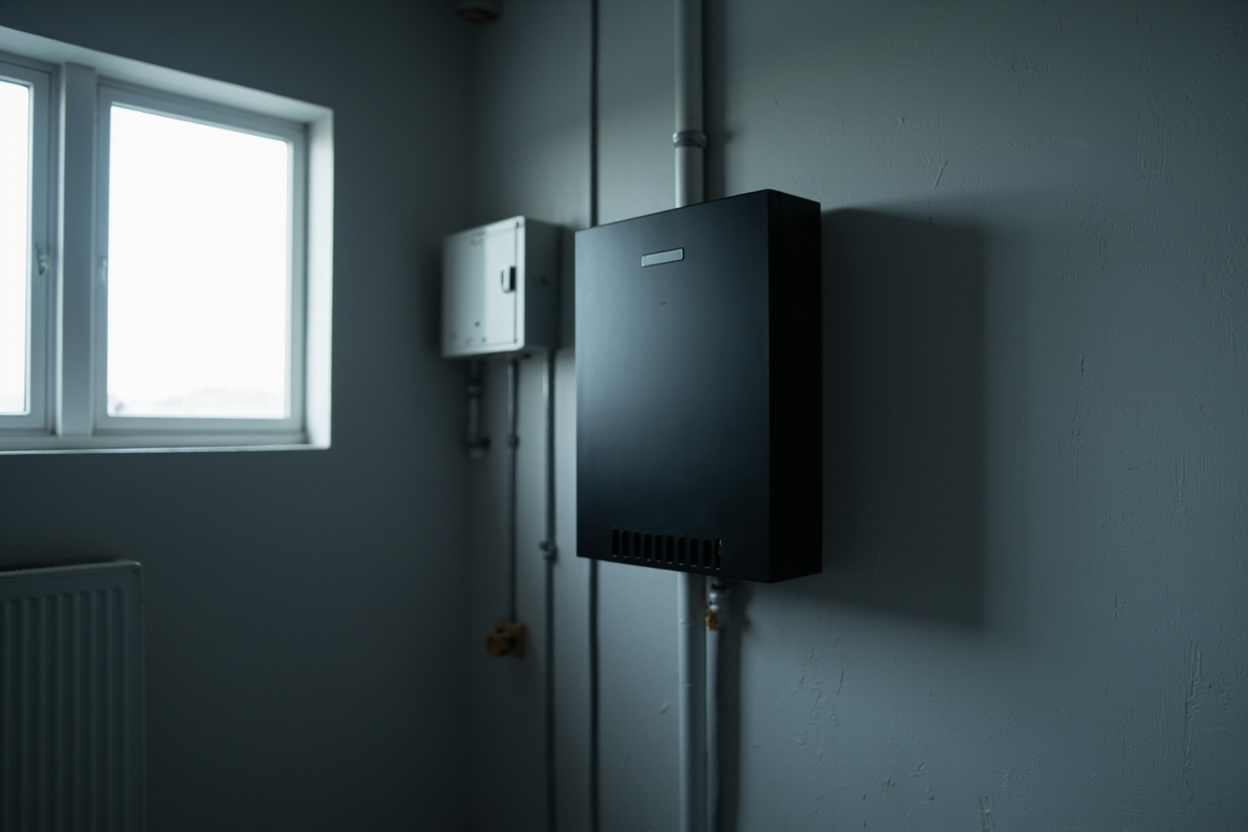
Price follows capacity. Installed complete, including inverter, cabling and its own circuit, a home battery usually costs between 700 and 1,100 euros per usable kilowatt-hour, which puts a five to eight kilowatt-hour system at 3,500 to 8,800 euros. Unlike solar panels, a battery generally does not fall under the zero VAT rate, so ask for a quotation that states the rate applied per item.
Whether it repays itself is a question about your consumption, not about the product. The return per stored kilowatt-hour is the gap between what you pay and what you would have received for exporting, multiplied by what you can genuinely push through the battery in a year. Someone who is home during the day and already consumes much of their own output has less left to store, and therefore gets less from storage, not more.
Adding a battery later is always possible. An AC-coupled unit works alongside any existing installation and asks nothing of your panels; its round-trip efficiency is a few percent below a hybrid inverter storing DC directly. If you are installing panels now and might store later, choose an inverter with headroom and decide nothing else today.
On siting: a battery wants a dry, ventilated space that stays above freezing in winter. A utility room or an attached garage usually qualifies; an unheated outbuilding does not. Tell your buildings insurer as well, since some policies set conditions on placement.
There is no national subsidy for home batteries in the Netherlands. Provinces have run their own schemes from time to time, varying by year and by budget, sometimes with the condition that the battery must not export during peak hours. Cost a battery without any subsidy: if the sum only works with one, you are buying the subsidy rather than the battery, and that is a thin reason for something that has to last fifteen years.
One local point. In Haarlemmermeer the pressure on the network is on the consumption side, so a battery that flattens your evening peak solves a different problem from one that avoids exporting, and it is the first of those two that means anything here.
Ranges, not promises. What your roof does follows from the survey, not from this figure.
Questions about home battery in hoofddorp
Will a home battery pay for itself?
For an average household with panels only, usually not inside the warranty period. The return is the gap between your retail rate and your feed-in payment, multiplied by what actually passes through the battery: five usable kilowatt-hours over 300 cycles comes to roughly 270 euros a year against an investment of 3,500 to 5,500 euros. The sum turns around with a large surplus, a heat pump or charger, or a dynamic tariff.
How many kilowatt-hours do I need?
About as many as you use between six in the evening and seven the next morning on a mild day. For most homes that is four to eight usable kilowatt-hours. Buying larger adds no return, because the battery simply never empties before the sun comes up again.
Can I add a battery later?
Yes. An AC-coupled battery works next to any existing array and asks nothing of your panels; efficiency is a few percent below a hybrid inverter that stores the DC directly. If you are having panels fitted now and may store later, pick an inverter with headroom.
Will I still have power during an outage?
Usually not. A grid-tied inverter must disconnect during a fault, so that nobody working on a cable meets live wires. Backup power needs a separate circuit and extra switchgear, which is a second quotation rather than an option on the first.
Does the battery change my connection?
Not on its own: it goes on its own circuit in the existing consumer unit. It does count once a heat pump or a car charger joins it, since all three share one main fuse. In this region the network pressure sits precisely on that consumption side, so it is a real consideration rather than a theoretical one.
Is there a subsidy?
Nothing national. Provinces have run their own schemes at times, varying by year and budget, occasionally on condition that the battery does not export during peak hours. Cost the battery without a subsidy: if it only works with one, the subsidy is what you are buying.